
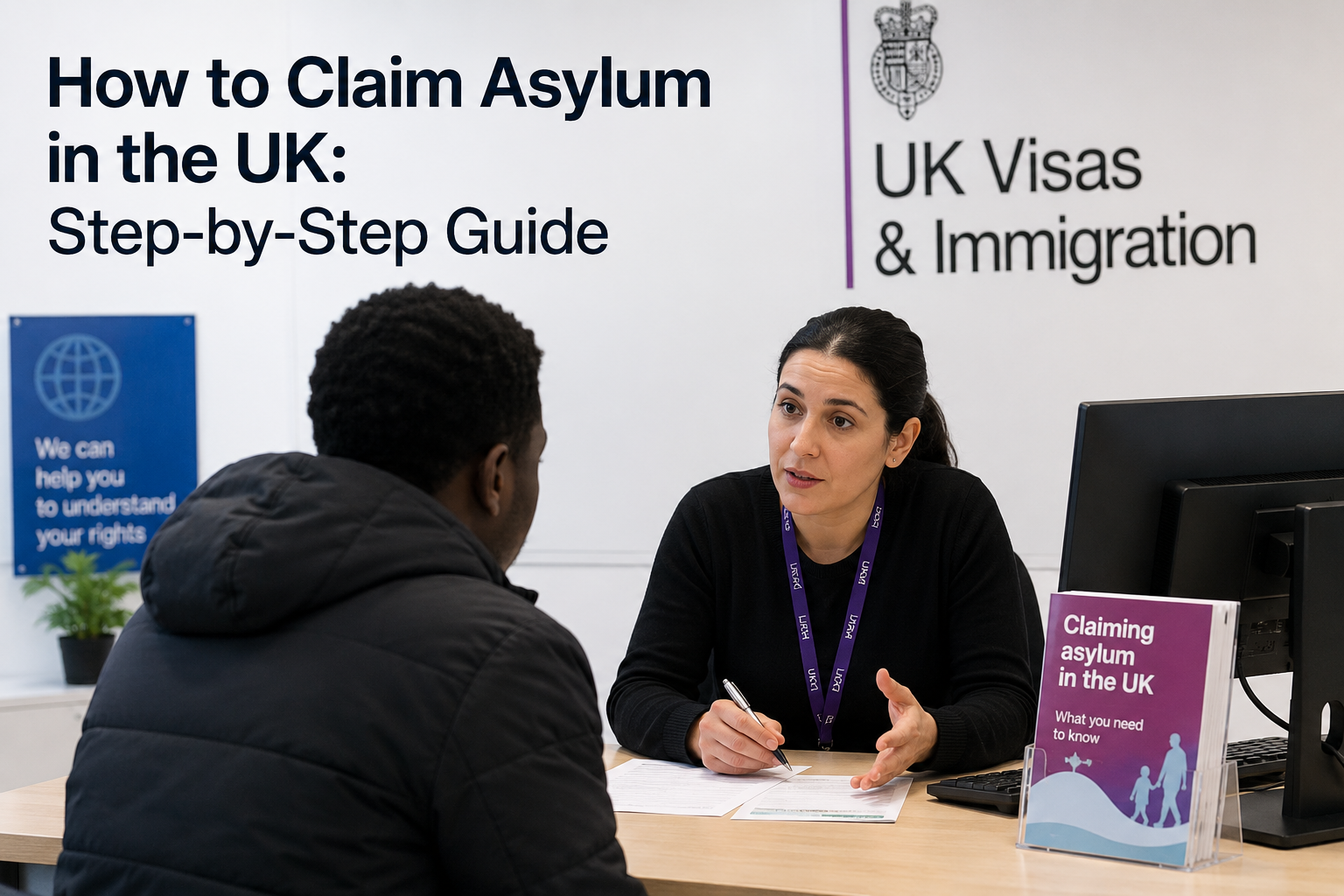
Claiming asylum can be one of the most important processes a person goes through. If you believe it is unsafe to return to your country because you fear persecution, understanding what happens next can make the process feel clearer and help you prepare for each stage.
A UK asylum claim is not the same as applying for a visa. It is a request for protection from someone who has left their country and cannot safely return.
This guide explains the main stages of claiming asylum in the UK, from registering your claim through to receiving a decision.
For wider information and support, visit our Asylum & Refugee Support page.
LawNeeds is not a law firm and does not replace regulated legal advice.
Who Can Claim Asylum in the UK?
To be recognised as a refugee in the UK, you must have a well-founded fear of persecution for a reason connected to your race, religion, nationality, political opinion or membership of a particular social group, and you must be unable or unwilling to seek protection from your country’s authorities.
As part of assessing a claim, the Home Office also considers whether it would be safe and reasonable for you to live in another part of your country – known as internal relocation. Whether this applies depends on the individual circumstances of the claim.
Whether someone meets the legal requirements for refugee status is a fact-specific assessment. If you are unsure whether asylum is the right route for you, speaking to a regulated immigration adviser or solicitor before making any claim is strongly recommended.
According to GOV.UK, the persecution must relate to your race, religion, nationality, political opinion or another characteristic that puts you at risk because of the social, cultural, religious or political situation in your country. Examples include risks connected to gender, gender identity or sexual orientation.
You must also have been unable to obtain protection from the authorities in your own country.
Whether someone meets the legal requirements for refugee status depends on their individual circumstances. If you are unsure whether asylum is the appropriate route for you, speaking to a regulated immigration adviser or solicitor before making any claim is strongly recommended.
Step 1: Claim Asylum as Soon as You Need Protection
GOV.UK states that you should claim asylum when you arrive in the UK or as soon as you believe it would be unsafe to return to your country.
Timing matters. Delaying an asylum claim can affect how it is considered, and GOV.UK warns that an application is more likely to be refused if you wait.
How you begin the process depends on where you are.
If You Arrive at the UK Border
Tell a Border Force officer that you want to claim asylum.
Your claim will be registered and you will attend an asylum screening. You can ask for an interpreter at any stage, if you need one.
If You Are Already in the UK
Contact the Home Office Asylum Intake Unit to arrange a screening appointment. You have the right to request an interpreter during that call.
If you are homeless, you can attend in person without an appointment and explain that you are homeless and need accommodation.
Your asylum claim is not registered by making the initial call. It is registered when you attend your screening appointment and the claim is formally recorded.
Step 2: Gather the Documents You Have
Prepare the documents available to you before your asylum screening.
GOV.UK says documents to bring, where you have them, include:
- Passports and travel documents
- Identity cards
- Birth certificates
- Marriage certificates
- School records
- Documents or other material you believe support your claim
If you are already living in the UK, you and any dependants included in your claim must also provide evidence of your UK address. The documents required depend on whether you have your own accommodation or are staying with another person.
Not having every possible document is not a reason to invent or alter evidence.
The information you provide to the Home Office must be truthful and accurate. Giving false information in an asylum application can have serious consequences, including affecting any future immigration applications.
If you have evidence but are unsure whether it is relevant or how it should be presented, this is an area that professional immigration advice can help you think through before your screening.
Step 3: Attend Your Asylum Screening
Your screening is the stage at which your asylum claim is formally registered.
It is a meeting with an immigration officer and is different from the later substantive asylum interview. It is shorter and focuses on gathering basic information about you.
During screening, the Home Office will:
- Take your photograph
- Take your fingerprints
- Ask questions to establish your identity
- Ask where you are from
- Ask why you are claiming asylum
- Ask for relevant health and medical information
You can provide written evidence and other relevant documents at this stage.
If you need an interpreter, tell the asylum registration appointment service in advance. You can also request a male or female interviewer, although GOV.UK states this cannot always be guaranteed.
If your partner or children under 18 are included as dependants on your asylum claim, you must bring them to the screening appointment.
Step 4: Wait for the Home Office to Decide Whether Your Claim Can Be Considered in the UK
After screening, the Home Office reviews your case and decides whether your asylum claim can be considered in the UK.
Unless you are detained, you will usually be sent an Application Registration Card, commonly called an ARC. This is an identity document confirming that you have made an asylum claim. Keep it with you.
The ARC may also state whether you have permission to work, but having an ARC does not automatically mean you have that permission – check what your ARC says carefully.
You may also be sent a Preliminary Information Questionnaire, or PIQ. If you receive one, you must complete and return it by the deadline stated in the accompanying letter.
Seek immigration advice before returning it if you can – this questionnaire can be important to your claim.
Read all Home Office correspondence carefully and keep your contact details updated at all times.
Could an Asylum Claim Be Considered Inadmissible?
Not every asylum claim proceeds directly to substantive consideration in the UK.
GOV.UK states that a claim might not be considered where, for example, the person has a connection to a safe third country where they could have claimed asylum.
After screening, the Home Office can consider whether another safe country should be responsible for the claim. If no such arrangement can be made, GOV.UK states the case will be considered in the UK and allocated to a caseworker.
Questions about inadmissibility and safe third countries can involve complex legal issues that can significantly affect the outcome. Professional immigration advice is essential if inadmissibility becomes relevant to your case.
Step 5: Follow Home Office Instructions While Your Claim Is Pending
Once your asylum claim is being considered, there will be ongoing requirements. Missing them can have serious consequences.
You may be required to attend regular meetings known as reporting events.
GOV.UK warns that failing to attend reporting events can result in your asylum claim being withdrawn and can also lead to detention.
You must also tell the Home Office if relevant details change, including your contact information or circumstances.
Keep copies of important letters, emails and other correspondence.
It helps to maintain an organised record containing:
- Your Home Office reference information
- Your ARC
- Appointment letters
- Important dates and deadlines
- Copies of evidence you have provided
- Home Office correspondence
- Details of reporting events
- Questions for your legal representative
Staying organised makes it easier to understand what is happening and identify anything that requires urgent action.
Step 6: Attend Your Asylum Interview
If your claim is being considered in the UK, you will have a substantive asylum interview with a Home Office caseworker.
GOV.UK states that most asylum interviews currently take place by video call. You will receive a letter telling you when and how your interview will take place.
The asylum interview is one of the most important stages of the entire process. How you prepare for it matters.
It is your opportunity to explain why you are seeking protection, including:
- What happened to you
- The persecution you experienced or fear
- Why you are afraid to return
- Why you cannot obtain protection in your country
- Other information you want the Home Office to consider
The interview can involve questions about difficult or sensitive experiences. Answer truthfully and accurately – do not try to give the answers you think the Home Office wants to hear. Consistency and honesty carry more weight than how an account sounds.
GOV.UK states that information given in the interview is confidential and will not be shared with the authorities in your country.
An interpreter will be provided if you need one, and you can bring a legal representative such as an immigration adviser, solicitor or lawyer.
We cover this stage in more detail in our guide to What Happens at a UK Asylum Interview?
Step 7: Provide Relevant Evidence
Evidence can be important – sometimes decisive – in how the Home Office considers an asylum claim.
Before an asylum interview, GOV.UK currently instructs applicants to provide original identity documents they hold, such as a passport, national identity card or birth certificate.
Foreign-language documents submitted for the interview must be translated into English and must identify who carried out the translation.
You can also provide evidence relating to the persecution you experienced or fear, and other material you believe supports your claim.
What counts as relevant evidence depends on your individual circumstances.
Our separate guide, What Evidence Do You Need for a UK Asylum Claim?, explores this topic in greater detail.
Step 8: Wait for the Home Office Decision
After considering your claim, evidence and relevant information, the Home Office will make a decision.
There are several possible outcomes.
If your protection claim succeeds, you may receive:
- Refugee status
- Humanitarian protection
In some circumstances, permission to stay may be granted for another reason.
For asylum claims made on or after 2 March 2026, someone granted refugee status or humanitarian protection receives a minimum of 30 months’ permission to stay under the current rules, after which they must apply to extend.
For claims made before 2 March 2026, the current GOV.UK guidance provides for a minimum five-year period where refugee status or humanitarian protection is granted.
Unaccompanied children have separate provisions and generally continue to receive five years’ permission.
Because immigration rules can change, always check the permission stated in your Home Office decision rather than relying on older information.
What Happens If Your Asylum Claim Is Refused?
A refusal does not always mean the end of the road – but it does require you to act quickly.
If the Home Office decides you do not qualify for refugee status or another form of permission to remain, you will receive a written decision explaining the outcome.
Most refused asylum seekers have a right to appeal to the First-tier Tribunal (Immigration and Asylum Chamber), though this depends on the type of decision and the circumstances of the refusal.
GOV.UK states that a person who has no other reason to stay will be required to leave the UK if they do not appeal within the permitted time or if their appeal is unsuccessful.
Do not assume that every refusal has the same next step.
The options available depend on your decision, your circumstances and any appeal rights you have.
If your asylum claim has been refused, consider obtaining regulated immigration advice promptly, particularly where a deadline applies.
Read our guide to What to Do If Your UK Asylum Claim Is Refused for more information.
How LawNeeds Can Help
Claiming asylum can involve multiple appointments, documents, deadlines and important questions – often at the most stressful time of a person’s life.
LawNeeds can help you:
- Understand the stages of the asylum process
- Organise questions about your situation
- Keep important issues clearer
- Understand common immigration terminology
- Access AI-powered legal support tools
- Prepare questions to raise with an immigration professional
- Identify when regulated professional support may be needed
LawNeeds does not decide whether you qualify for asylum and cannot guarantee the outcome of an asylum claim.
Asylum cases can involve complex legal and evidential issues. Regulated immigration advice is recommended.
LawNeeds is not a law firm and does not replace regulated legal advice.
Visit our Asylum & Refugee Support page for wider information and support.