
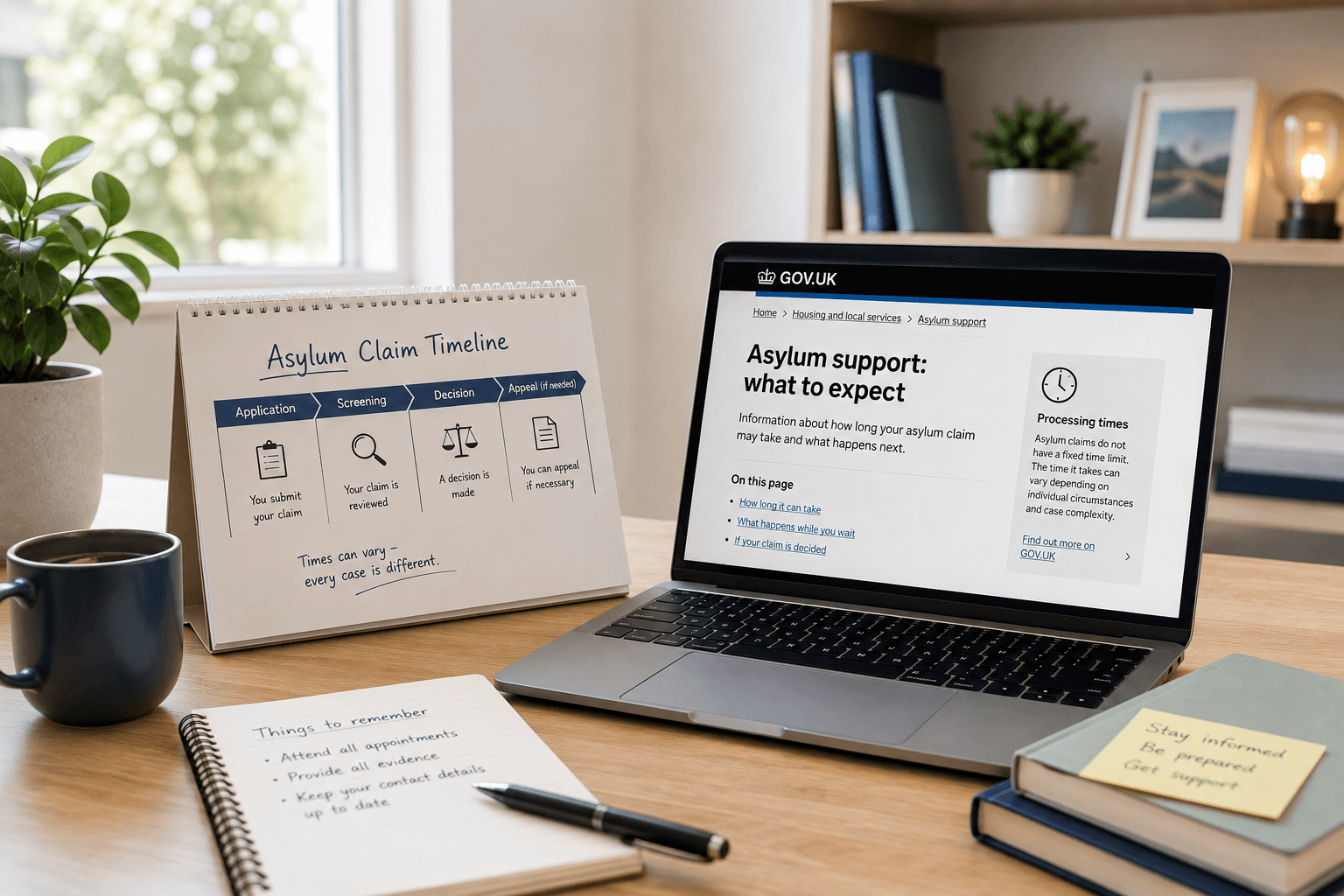
There is no fixed processing time for a UK asylum claim.
GOV.UK states that asylum applications will be decided as soon as possible, but it does not give a standard number of weeks or months within which every applicant will receive a decision. The time required depends on the individual claim and the work the Home Office needs to complete before deciding it.
Some people receive decisions much sooner than others. More complex claims, requests for further evidence, additional interviews and other case-specific factors can make the process longer.
This guide explains the different stages of the asylum process, why delays can happen and what you can do if you have been waiting for a decision.
For wider guidance, visit our Asylum & Refugee Support page.
LawNeeds is not a law firm and does not replace regulated legal advice.
Is There an Official UK Asylum Processing Time?
No standard processing deadline applies to every asylum claim.
GOV.UK guidance simply states that an asylum application will be decided as soon as possible. Be cautious about websites or social media posts that suggest every asylum claim should be decided within a particular number of months – there is no universal timetable.
An asylum claim can involve several stages before the Home Office is able to make an initial decision, including:
- Asylum screening
- Consideration of whether the claim can be examined in the UK
- Allocation to a caseworker
- An asylum interview
- Consideration of supporting evidence
- Requests for further information where necessary
- A further interview in some cases
- A final initial decision
After screening, the Home Office first reviews the case and decides whether the asylum claim can be considered in the UK. If it can, the claimant will normally proceed to an asylum interview before a decision is made.
How Soon Does the Asylum Interview Take Place?
GOV.UK says that an asylum interview will usually take place soon after screening, although it does not provide a guaranteed timeframe.
You will receive a letter explaining when and how the interview will take place. Most asylum interviews currently take place by video call.
The timing can therefore vary from one person to another.
Receiving an interview does not mean that a decision will follow immediately. The two can be separated by a significant period.
How Long After an Asylum Interview Will You Get a Decision?
There is no published standard period between an asylum interview and a decision.
After the interview, the Home Office may still need to consider documents, country information and other evidence before reaching its conclusion.
A further interview can also be arranged where additional information is needed.
This means two people who attend asylum interviews at the same time can receive decisions at very different times.
Why Can an Asylum Claim Take Longer?
There are many reasons why one asylum claim can take longer than another.
These can include:
- The complexity of the individual claim
- The amount of evidence that needs to be considered
- Additional documents being requested
- A further asylum interview being required
- Questions about identity or nationality
- Issues concerning whether the claim should be considered in the UK
- Information requiring further investigation
- The circumstances of dependants included in the claim
- Operational pressures and the volume of cases being handled by the Home Office
A longer wait does not, by itself, tell you whether your asylum claim will be accepted or refused.
How Many People Are Currently Waiting for an Asylum Decision?
The latest published Home Office statistics covering the position at 31 March 2026 recorded 48,758 people, relating to 35,744 cases, waiting for an initial asylum decision.
That represented a 55% reduction compared with March 2025 and was the lowest number awaiting an initial decision since September 2019.
The initial-decision backlog has fallen substantially, but tens of thousands of people were still waiting for an initial decision at the end of the reporting period.
These national statistics should not be treated as a prediction of how long your individual application will take.
Does the Home Office Process Asylum Claims in Order?
Do not assume that every asylum claim is decided strictly according to the date it was submitted.
Home Office casework involves different circumstances and priorities, meaning someone who claimed asylum after you could receive a decision first.
The relevant issue is the progress of your own claim – not trying to estimate your decision date by comparing your case with someone else’s.
What Should You Do While Waiting for an Asylum Decision?
Even when there appears to be little activity on a claim, there are several things that remain important.
Keep Your Contact Details Up to Date
The Home Office needs to be able to reach you at all times.
Current Home Office guidance allows asylum claimants to use its communications hub to update contact information and immigration adviser details.
If you move home, change your number or change your email address, follow the current Home Office procedure for reporting the change.
Missing important correspondence can have serious consequences for your asylum claim.
Read Every Home Office Letter Carefully
Do not assume a letter is simply a routine update.
It could contain:
- An interview appointment
- A reporting requirement
- A request for information
- A deadline
- A request for documents
- A decision
Keep copies of all correspondence and make a note of every important date.
Attend Required Appointments
You must continue to comply with the asylum process while waiting.
The Home Office can impose reporting requirements, and failure to comply can have serious consequences.
If you genuinely cannot attend an appointment, contact the Home Office rather than simply failing to appear.
Keep Relevant Evidence Organised
If new genuine evidence becomes available while your claim is being considered, discuss it with your legal representative.
Do not manufacture evidence simply because your claim has been outstanding for a long time.
Our guide to What Evidence Do You Need for a UK Asylum Claim? explains the different types of evidence that can be relevant.
Can You Ask the Home Office for an Update?
Yes.
The Home Office provides a process for requesting a progress update through the AHRO Central Communications Hub.
GOV.UK provides a template showing what information to include when making that request.
Provide the information specified in the current guidance so that your case can be identified.
If you have a legal representative, they can also contact the Home Office about your claim.
Will Asking for an Update Make the Decision Faster?
Requesting a progress update does not guarantee that the Home Office will make an immediate decision.
The purpose of a progress request is to obtain information about the status of the claim – not to create a deadline for a decision.
If there are particular reasons why a delay is causing serious difficulties or why you believe your case requires urgent consideration, discuss those circumstances with your regulated legal representative.
What If You Have Been Waiting More Than 12 Months?
Waiting more than 12 months can become relevant to your permission to work.
Asylum seekers are not normally permitted to work while their claim is being considered. However, someone whose asylum claim has been outstanding for more than 12 months can apply for permission to work if the delay in receiving an initial decision was not their fault.
Permission is not automatic simply because 12 months have passed. An application must be made, and restrictions apply if permission is granted.
For a more detailed explanation, read Can Asylum Seekers Work in the UK?
Can You Receive Financial Support While Waiting?
If you would otherwise be destitute while waiting for an asylum decision, you can be eligible for asylum support.
Current GOV.UK guidance says this can include:
- Accommodation
- Financial support
- Access to free state education for children
- Access to NHS healthcare in relevant circumstances
Eligibility depends on your circumstances.
At the end of March 2026, 97,519 people were receiving Home Office asylum support. This figure includes people at different stages of the asylum system and is not limited to people awaiting their first decision.
Our separate guide, What Support Can Asylum Seekers Get in the UK?, explains this in greater detail.
Does a Long Delay Mean Your Asylum Claim Is More Likely to Succeed?
No.
The amount of time your claim has been outstanding does not indicate whether the Home Office will grant or refuse protection.
A decision is based on the circumstances and evidence relevant to the claim – not how long the applicant has been waiting.
Do not treat a long delay as either a positive or negative sign about the outcome.
Does a Long Delay Mean Something Is Wrong With Your Claim?
Not necessarily.
A delay can happen for many reasons, and its existence alone does not tell you why the Home Office has not made a decision.
If you are concerned about the progress of your claim, you can request an update through the current Home Office process.
Where there are specific legal concerns about the delay, discuss them with a regulated immigration adviser or solicitor.
What If the Home Office Asks for More Evidence?
Respond carefully to any request for additional evidence.
Check:
- What information has been requested
- The deadline for responding
- How the evidence must be submitted
- Whether translation is required
- Whether you need professional advice about the request
Do not ignore a request because you have already attended your asylum interview.
The Home Office can require further information before reaching a decision, and a follow-up interview can be arranged.
If you cannot obtain requested evidence or need more time, speak to your legal representative promptly rather than letting the deadline pass.
What Happens When a Decision Is Finally Made?
The Home Office will tell you when it has reached a decision on your asylum claim.
Possible outcomes include being granted refugee status or humanitarian protection, being granted permission to stay for another reason in relevant circumstances, or having the asylum claim refused.
For people who claimed asylum on or after 2 March 2026, current rules generally provide a minimum of 30 months’ permission to stay where refugee status or humanitarian protection is granted, although unaccompanied asylum-seeking children are generally granted five years.
Different rules apply to claims made before that date and to some children, so check the terms of your individual Home Office decision rather than relying on general information.
What Happens If Your Claim Is Refused?
If your asylum claim is refused, the decision should explain the reasons and whether you have a right to appeal.
Do not simply wait after receiving a refusal. Asylum appeals involve strict deadlines.
From 13 July 2026, fees apply to most appeals to the First-tier Tribunal (Immigration and Asylum Chamber): £82 for an appeal without a hearing and £144 for an appeal with a hearing. Exemptions and fee-remission arrangements apply in some circumstances, including for people receiving asylum support or legal aid. Where a fee is payable, failure to pay can result in the appeal being struck out.
The length of an appeal is also separate from the time taken to make the original asylum decision. Based on tribunal statistics for January to March 2026, the mean time taken to clear an Asylum/Protection appeal was 67 weeks. This is a national statistical average and does not predict how long an individual appeal will take.
Read What to Do If Your UK Asylum Claim Is Refused for further information.
How to Stay Organised During a Long Asylum Claim
A long period without a decision can make it difficult to remember what has happened and what still needs attention.
It can help to keep one organised record containing:
Home Office Correspondence
Keep letters, emails and notices together.
Important Dates
Record your:
- Asylum claim date
- Screening date
- Interview date
- Reporting appointments
- Evidence submission dates
- Home Office requests
- Deadlines
Evidence
Keep a record of what you have provided and when.
Contact Information
Make sure the Home Office has your current:
- Address
- Email address
- Telephone number
- Legal representative details
Questions
Keep a running list of questions you want to raise with your immigration adviser or solicitor.
Good organisation cannot make the Home Office reach a decision, but it can help you understand your position and respond appropriately when something changes.
How LawNeeds Can Help
Waiting for an asylum decision can create uncertainty, particularly when months pass without knowing what will happen next.
LawNeeds can help you:
- Understand the main stages of the asylum process
- Organise questions about a delayed claim
- Keep key dates and issues clearer
- Understand common Home Office terminology
- Access AI-powered legal support tools
- Prepare questions for an immigration professional
- Identify when regulated professional support may be needed
LawNeeds cannot predict when the Home Office will decide your claim or guarantee that a progress request will result in a faster decision.
Where a delay raises significant legal or personal concerns, obtaining regulated immigration advice is strongly recommended.
LawNeeds is not a law firm and does not replace regulated legal advice.
Visit our Asylum & Refugee Support page for wider guidance.