
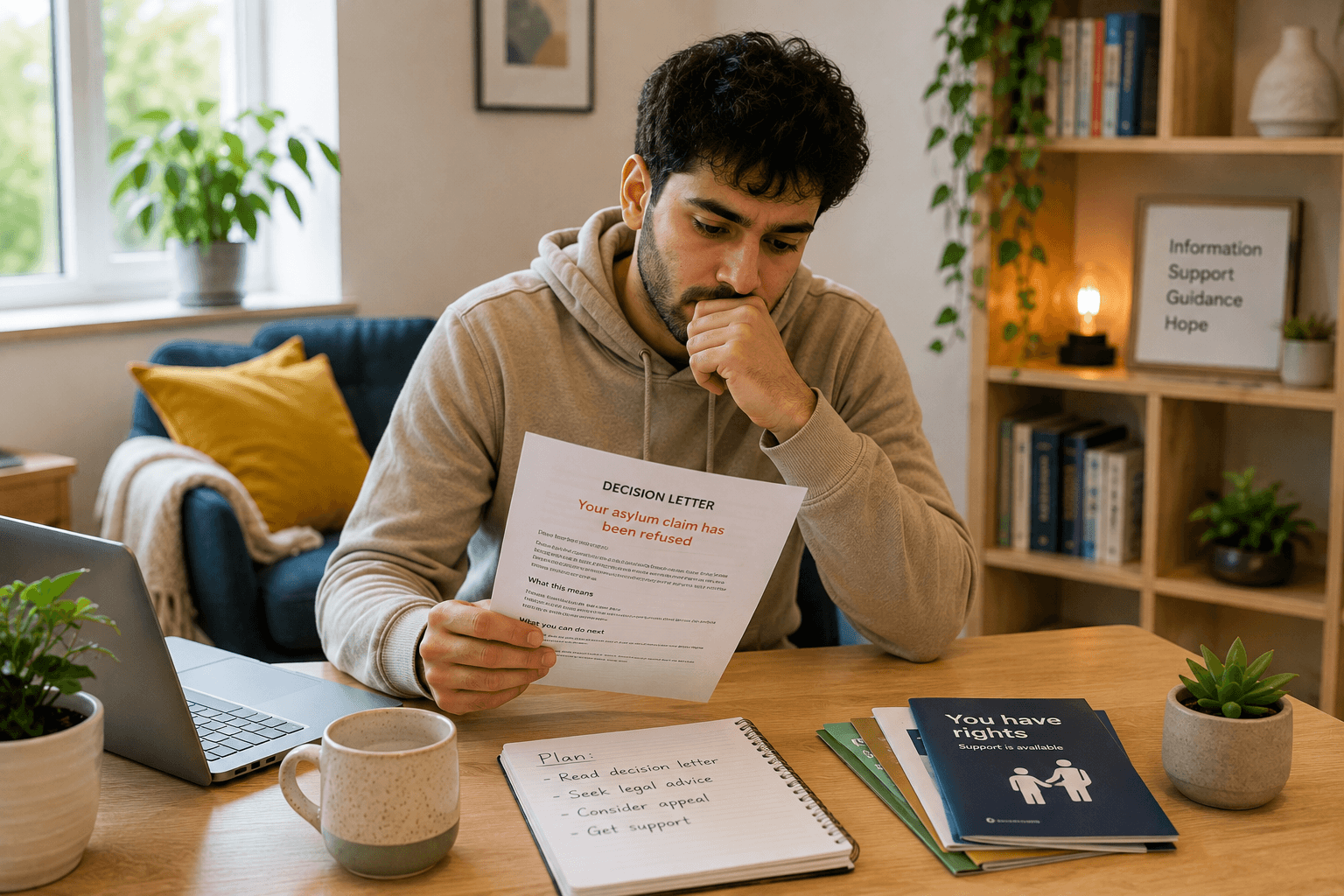
Receiving a refusal of your asylum claim can be frightening, particularly when you believe it is unsafe for you to return to your country.
A refusal does not mean that every case has the same next step.
Depending on your decision, you may have a right of appeal. If your appeal rights are later exhausted and genuinely new evidence becomes available, further submissions can be relevant in some circumstances.
What matters immediately is understanding why the Home Office refused your protection claim, whether you have a right to appeal and what deadline applies.
This guide explains the main steps to consider after receiving an asylum refusal.
For wider guidance, visit our Asylum & Refugee Support page.
LawNeeds is not a law firm and does not replace regulated legal advice.
What Happens When an Asylum Claim Is Refused?
If the Home Office refuses your protection claim and does not grant you another form of permission to stay, you will receive a decision explaining the outcome.
GOV.UK states that if there is no reason for you to stay, you will be asked to leave the UK. You may, however, have a right to appeal against the decision.
Your refusal decision is one of the most important documents in your case.
Do not ignore it.
Read it carefully and establish:
- Why your asylum claim was refused
- Which parts of your account the Home Office accepted
- Which parts it did not accept
- How your evidence was assessed
- Whether the Home Office believes you could return safely
- Whether another form of permission to stay was considered
- Whether you have a right to appeal
- The deadline for taking action
If you have a legal representative, send them the full decision as soon as possible.
Step 1: Read the Reasons for Refusal Carefully
An asylum refusal should explain why the Home Office reached its decision.
The reasons can differ significantly between claims.
For example, a refusal could involve questions about:
- Whether the Home Office accepts that particular events occurred
- The credibility of part of your account
- Differences between statements, documents or interviews
- Whether your evidence supports what you have said
- Whether the Home Office accepts that you face a future risk
- Whether protection is available from authorities in your country
- Whether the Home Office believes you could safely live elsewhere in your country
- Whether the risk you describe meets the legal requirements for protection
- Country information relied upon by the Home Office
Do not assume that the word “refused” tells you everything you need to know.
The detailed reasons matter – they determine what issues need to be addressed if the decision is challenged.
Step 2: Check Whether You Have a Right of Appeal
A refusal of a protection claim will often carry a right of appeal to the First-tier Tribunal (Immigration and Asylum Chamber), although there are exceptions. Your decision letter should explain whether you have a right of appeal.
GOV.UK states that the First-tier Tribunal can hear appeals where the Home Office has refused a protection claim, including an asylum or humanitarian protection claim. The tribunal is independent of government – a judge considers both sides before making a decision.
Your decision letter should tell you whether you have a legal right to appeal.
Do not assume that an option mentioned in somebody else’s asylum case automatically applies to yours.
If you are unsure whether you can appeal, obtaining regulated legal advice promptly is particularly important.
Step 3: Check the Appeal Deadline Immediately
Immigration and asylum appeals have strict time limits – and missing them creates serious difficulties.
For an appeal from inside the UK, you generally have 14 days from the date you receive the decision letter. If you are outside the UK, the standard period is 28 days.
Check your own decision letter carefully – it explains how the decision affects you and how to challenge it.
Do not wait until the end of the deadline before seeking professional support.
If an appeal is submitted late, you must explain why. The tribunal then decides whether it can still hear the appeal.
A late appeal should never be treated as equivalent to one submitted within time.
What Is an Asylum Appeal?
An asylum appeal asks an independent tribunal to consider the Home Office’s refusal of your protection claim.
It is not simply another asylum application.
The First-tier Tribunal is separate from the Home Office. A judge considers the arguments and evidence before making a decision.
Depending on how the appeal proceeds, you can provide documents in support of your case and request a hearing.
The current online appeal service allows you to:
- Submit an appeal
- Add supporting documents
- Ask for a hearing
- Request adjustments or additional support
- Receive the appeal decision
Because an appeal involves legal arguments about an existing Home Office decision, professional representation can be particularly valuable.
Should You Appeal Every Asylum Refusal?
There is no single answer that applies to every case.
The important question is whether you have a right of appeal and what legal and factual issues arise from your decision.
You should not submit an appeal simply because another person with an asylum refusal appealed successfully.
Equally, you should not assume there is no point appealing simply because the Home Office has refused your initial claim.
A regulated immigration adviser or solicitor can review the decision, evidence and circumstances and advise you on the appropriate legal response.
LawNeeds can help you organise the questions you need to raise, but it does not determine whether you should bring an appeal.
What Should You Look for in an Asylum Refusal Letter?
When reviewing the decision, separate the issues into categories.
Facts the Home Office Accepts
Identify events, background information or other facts that the Home Office says it accepts.
Facts the Home Office Disputes
Make a note of the parts of your account that were rejected or questioned.
Credibility Findings
Identify any concerns about inconsistencies, plausibility, delay, documents or information given at different stages of your claim.
Evidence
Check which documents were considered and what the decision says about them.
Risk on Return
Understand why the Home Office believes you would or would not face a relevant risk if returned.
Protection in Your Country
Check whether the Home Office believes the authorities in your country could protect you.
Internal Relocation
The Home Office can consider whether it believes you could safely and reasonably live somewhere else within your country.
Appeal Rights
Identify exactly what your decision says about challenging the refusal and the applicable deadline.
A clear list can help you prepare more focused questions for your legal representative.
What If the Home Office Says Your Account Is Not Credible?
Credibility can be an important issue in asylum refusals.
A decision can raise concerns about matters such as:
- Differences between your screening and asylum interview
- Different dates or sequences of events
- Documents the Home Office does not accept
- Information the Home Office believes is inconsistent with country evidence
- Information disclosed at a later stage
- Parts of an account considered implausible
Do not respond by inventing an explanation for every point.
If there is a genuine reason for a difference or omission, explain it truthfully.
Relevant circumstances can include issues affecting someone’s ability to provide evidence, and Home Office decision-making guidance requires evidence to be assessed in the context of the individual claim.
Where credibility forms a major part of a refusal, professional immigration advice can be especially important because these findings can affect several parts of an asylum case.
What If the Home Office Has Misunderstood Something You Said?
If you believe the refusal is based on an incorrect understanding of your evidence, identify the issue precisely.
For example:
- What does the refusal say?
- What did you actually say?
- Where is the relevant information recorded?
- Is it in your screening record?
- Is it in the asylum interview record?
- Is there documentary evidence?
- Was there an interpretation problem?
- Is there other evidence relevant to the issue?
Do not alter your account simply to make information fit together.
Organise the genuine information available and discuss the point with your legal representative.
What If Important Evidence Was Not Considered?
If you believe evidence relevant to the decision was overlooked, make a clear record of:
- What the evidence is
- When it was submitted
- How it was submitted
- Why you believe it is relevant
- Whether the refusal refers to it
Keep copies of submission emails, documents and other records where available.
Whether an apparent failure to consider particular evidence affects the legal validity of a decision is a question that requires regulated legal advice.
Can You Provide New Evidence During an Appeal?
Evidence can form part of an immigration and asylum appeal.
The current tribunal process allows an appellant to add documents supporting their appeal.
However, you should not assume that simply finding more documents will automatically overturn the Home Office’s decision.
Evidence should be genuine and relevant.
Depending on your circumstances, this could include material relating to:
- Events relevant to your protection claim
- Medical or psychological circumstances
- Country conditions
- Witness evidence
- Your identity or background
- Matters disputed in the refusal
- Developments that occurred after the Home Office decision
Never fabricate or alter evidence. The consequences are serious and can extend well beyond the asylum process itself.
What Happens at an Asylum Appeal Hearing?
You can ask for the matter to be decided at a hearing or, where appropriate, on the documents supplied to the tribunal.
The tribunal can decide that a hearing is needed even if you did not request one.
At an appeal hearing, the tribunal judge considers the case independently.
The exact process will depend on the appeal and whether you have legal representation.
GOV.UK states that you can also request additional support or adjustments, including an interpreter or wheelchair access. Requests can be made for a private hearing or attendance by video where there is an appropriate reason.
If you have a representative, discuss the hearing process with them before the date.
Does It Cost Money to Appeal an Asylum Refusal?
Yes, tribunal fees now apply.
From 13 July 2026, fees are charged for asylum appeals:
- £82 for an appeal decided on the documents without a hearing
- £144 for an appeal with a hearing
GOV.UK states that you might not have to pay if you receive asylum support, receive legal aid or meet other relevant conditions for fee remission.
Failure to pay the fee can result in the appeal being struck out. Do not ignore the fee requirement.
Can You Get Legal Aid for an Asylum Appeal?
Legal aid can be available for immigration and asylum matters in qualifying circumstances.
Whether you personally qualify depends on the applicable legal-aid requirements and your situation.
You do not have to pay the tribunal fee if you receive asylum support or legal aid, or if another applicable exemption applies.
Given the importance of an asylum appeal, check whether regulated legal representation and legal aid are available to you as early as possible. You can find a free and qualified immigration lawyer through GOV.UK’s legal aid finder.
What Happens If Your Appeal Is Successful?
If the tribunal allows your appeal, the effect depends on the decision and circumstances of the case.
Your legal representative can explain what happens next and whether further Home Office action is required.
Do not assume that every successful appeal results in exactly the same administrative process or immigration status.
Keep all tribunal and Home Office correspondence after the appeal decision.
What Happens If Your Appeal Is Unsuccessful?
An unsuccessful First-tier Tribunal appeal does not mean you should automatically submit another challenge.
There can be circumstances in which permission to appeal to the Upper Tribunal is sought because of an alleged legal error in the First-tier Tribunal’s decision.
That is a legal process with its own rules and deadlines – it is not simply an opportunity to repeat the same asylum case because you disagree with the result.
If your First-tier Tribunal appeal is dismissed, consider obtaining regulated legal advice promptly about whether any further legal challenge is available.
What Does “Appeal Rights Exhausted” Mean?
A person is generally described as ‘appeal rights exhausted’ when there is no outstanding right of appeal in relation to the relevant decision.
This can happen where:
- No appeal is brought within the permitted process
- An appeal is dismissed and there is no further successful challenge
- Available appeal routes have been completed
The precise legal position depends on the case.
This stage can be important because different rules apply once there is no outstanding appeal.
For example, further submissions are intended for people whose previous protection claim has been refused or withdrawn and who have no remaining right of appeal.
Can You Submit New Evidence After All Appeals Have Finished?
Potentially.
If your asylum claim has been refused or withdrawn, you are in the UK and you have no outstanding relevant claim or appeal, you may be able to make further submissions.
This is not the same as simply repeating your original asylum application.
Current GOV.UK guidance states that the evidence must be genuinely new – submissions can be rejected where they simply reproduce evidence already supplied.
You must also have completed every available appeal process and must not have another claim or appeal outstanding with the Home Office or a court.
Further submissions can involve complicated legal questions about whether new material amounts to a fresh claim, so professional immigration advice is strongly recommended before taking this step.
What Are Further Submissions?
Further submissions allow someone whose protection or human-rights claim has previously been refused or withdrawn to provide further material after the relevant appeal process has ended. Making further submissions does not automatically mean that a new protection claim has been accepted or that the person has a new right of appeal.
Home Office guidance states that the process covers further submissions following refusal of a protection or human-rights claim where appeal rights have been exhausted, as well as certain withdrawn claims.
Further submissions can include genuinely new circumstances or evidence.
Examples include:
- Relevant events that occurred after the original decision
- New evidence that was not previously available
- Material changes in country conditions
- New personal circumstances relevant to protection or human rights
- Evidence relating to an issue in the previous decision
Whether particular evidence is sufficient to create a new protection claim is a legal assessment.
LawNeeds cannot determine whether your proposed further submissions meet that test.
Can You Submit Further Evidence From Outside the UK?
Under the current GOV.UK further-submissions process, no.
GOV.UK states that new evidence under this process cannot be submitted from outside the UK.
For protection-based further submissions, the standard process requires them to be made in person at a designated Service and Support Centre, unless permission is given to submit remotely in qualifying circumstances.
Check the latest GOV.UK process before taking any action – procedural requirements can change.
Can You Simply Make Another Asylum Claim After a Refusal?
You should not assume that a refused asylum seeker can simply start the whole process again from the beginning.
Where appeal rights have been exhausted, the Home Office has a specific further-submissions process for protection evidence.
Whether further submissions amount to a fresh claim depends on the legal test in the Immigration Rules. The Home Office considers whether the submissions are significantly different from material previously considered and, taken together with the earlier material, create a realistic prospect of success before an Immigration Judge.
This is an area where regulated professional advice is important.
What Happens to Asylum Support After a Refusal?
A refusal does not mean support stops immediately – but the position depends on where you are in the process.
If you submit an in-time appeal, section 95 asylum support continues during the appeal period. Support does not stop simply because the Home Office has refused your initial claim.
If your asylum claim is refused and you do not have a pending appeal, section 95 support will normally end after the applicable 21-day period. If you lodge an appeal, section 95 support can continue while the appeal is pending.
Failed asylum seekers who are destitute and cannot leave the UK may be able to apply for section 4 support, a more limited form of support available in specific circumstances.
Do not ignore any Home Office correspondence about your support. Read it carefully and seek appropriate help if you are at risk of homelessness.
For more information, see What Support Can Asylum Seekers Get in the UK?
Can You Continue Working After an Asylum Refusal?
If you previously received permission to work as an asylum seeker because your initial decision had been outstanding for more than 12 months, that permission does not continue permanently.
Home Office guidance states that asylum-seeker permission to work ends when the protection claim has been refused and any appeal rights are exhausted.
If this affects you, check your current immigration position before continuing or starting any employment.
A person who later makes qualifying protection-based further submissions may, in some circumstances, be able to apply for permission to work if those submissions have been outstanding for more than 12 months and the relevant conditions are met.
Our guide Can Asylum Seekers Work in the UK? explains the permission-to-work rules in greater detail.
Does an Asylum Refusal Mean You Will Be Removed Immediately?
Not necessarily – but do not rely on assumptions.
GOV.UK states that where someone does not qualify to remain, they will have to leave if they do not appeal in the time allowed or their appeal is unsuccessful. Removal can ultimately follow where there is no lawful basis to remain.
However, the position depends on matters including:
- Whether you have an appeal right
- Whether an appeal has been lodged
- Whether another legal challenge is outstanding
- Whether further submissions are relevant
- Your individual immigration circumstances
Obtain regulated legal advice where possible so that your exact position can be assessed.
Should You Leave the UK After an Asylum Refusal?
Do not make a major decision based solely on the fact that you have received a refusal.
First establish whether you have a right to challenge the decision and what deadline applies.
If there is no successful appeal or other lawful basis to remain, the person may be required to leave the UK and may ultimately be subject to removal.
Whether and when that applies to you depends on your individual case.
A Practical Checklist After Receiving an Asylum Refusal
If you receive a refusal, it can help to work through the following steps.
1. Record the Date You Received the Decision
This can be important when calculating an appeal deadline.
2. Read the Entire Refusal
Do not rely only on the first page or outcome.
3. Check Your Appeal Rights
Identify exactly what the decision says.
4. Check the Deadline
For an in-country appeal under the current general tribunal rules, this is ordinarily 14 days from receiving the decision.
5. Contact Your Legal Representative
Send them the full decision promptly.
6. Organise Your Previous Evidence
Keep your screening, interview records, statements and supporting documents together.
7. Identify the Home Office’s Main Reasons
Make a clear list rather than trying to respond to everything from memory.
8. Identify Relevant Evidence
Note which documents support the points raised in the refusal.
9. Do Not Fabricate New Evidence
Only use genuine information.
10. Monitor Your Asylum Support
Read any correspondence about accommodation or financial support.
11. Keep Complying With Home Office Requirements
Continue attending required reporting events and following instructions unless you are formally told otherwise.
12. Get Professional Advice
Asylum refusals can involve important legal rights and strict deadlines.
How LawNeeds Can Help
A refusal letter can contain many pages of legal reasoning, evidence assessment and Home Office terminology.
LawNeeds can help you:
- Organise the issues raised in your refusal
- Understand common asylum and appeal terminology
- Keep important dates and questions clearer
- Identify the parts of the decision you need to discuss with a professional
- Access AI-powered legal support tools
- Organise questions about evidence
- Understand when regulated professional support may be needed
LawNeeds cannot tell you that an appeal will succeed, act as your legal representative or determine whether particular evidence creates a fresh claim.
Because asylum refusals can involve strict deadlines and serious consequences, regulated immigration advice may be particularly important.
LawNeeds is not a law firm and does not replace regulated legal advice.
Visit our Asylum & Refugee Support page for wider guidance.